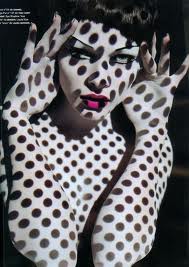
Dentro de un proceso creativo, creo en los accidentes, en los fallos, en las mentiras. De los errores, a veces, nacen las formas más bellas e inexplicables, y los mejores resultados. Mi trabajo consiste en esta serie de errores, de situaciones incontrolables y de azar. Para la realización de mis “estampados” he realizado una serie de fotocopias de radiografías que posteriormente he digitalizado.
Malgosia Bela con estilismo de Jacob K, maquillada por Lisa Butler y fotografiada por Tim Walker para Vogue UK December 2012.
Patricia Narbón
3.1.13
EL MUNDO SECRETO DE LA ALTA COSTURA
Anoche, en el Canal 33, dentro del programa 60 minutos, emitieron el documental titulado "El mundo secreto de la alta costura", realizado por la BBC en el año 2006.
Chanel 2006 Este documental se pudo realizar gracias a las entrevistas con los diseñadores más influyentes y conocidos dentro de la alta costura como Karl Lagerfeld, John Galliano, Valentino y Cristian Lacroix. Y también con la participación de algunas mujeres pertenecientes a los clubs más selectos y exclusivos del mundo con apenas 200 miembros. Una reflexión sobre cómo puede terminar éste mundo de lujo y glamour. Aquí dejo el enlace: http://www.tv3.cat/videos/4402751/60-minuts---Reportatges---capitol-42 Espero que os guste! Helena Ruiz mm1
Dirije la revista Metrópolis. Durante los años 90, abordó la vida de las supermodelos
y más particularmente la de Christy Turlington.
En la actualidad, trabaja principalmente para diseñadores y proveedores de Chanel; su propósito es mostrar la creación de una colección de costura desde el principio hasta el fin, para exponer todas las personas que están detrás de la creación de una pieza única. Este es el aspecto de este trabajo muy profesional.
Para este proyecto, Loïc Prigent tenía la luz verde de la Casa de Chanel dirigida por Karl Lagerfeld. Sin embargo, el director no tenía acceso a los talleres de los perfumes. Fue un trabajo muy complejo y el equipo hizo todo lo posible para no molestar a los trabajadores.
La idea de esta película le vino durante un prestigioso evento. Oyó que una mujer comentava que los diseñadores habian dedicado 3.000 horas de trabajo para realiza su vestido, Así que pensó que sería interesante mostrar el progreso de este trabajo.
FILMOGRAFIA/DOCUMENTALES RECOMENDADOS:
A Conversation With Loïc Prigent, Fashion Geek
September 8, 2009
There’s fiction—Ugly Betty, The Devil Wears Prada. There’s “reality”—Project Runway, America’s Next Top Model, The Rachel Zoe Show, and so on, ad nauseum. Now comes reality. Tomorrow night, the Sundance Channel debuts The Day Before, a documentary series portraying the final hours before the Sonia Rykiel, Proenza Schouler, Fendi, and Gaultier Haute Couture fashion shows. Commanding access that should make the hair of any fashion aspirant stand on end, director Loïc Prigent takes pains to show the real life of fashion, as sublime, as surreal, as high-stakes and as prosaic as it is, day-to-day. Dresses unsewn mere minutes before the lights go up on the catwalk. Missing models. Technical mishaps. Whacked-out seamstresses staging a 1 a.m. runway show. Alongside The September Issue, the series effectively counterpunches the prevailing public image of fashion people as a community of shopaholic psychotics, replacing it with something richer, stranger, and—yes—realer. Prigent himself is no stranger to the scene behind the scenes: Together with Agnès Boulard, Prigent produces a popular fashion-themed show for French television, and he directed the the miniseries Signé Chanel and the documentary Marc Jacobs & Louis Vuitton, both of which previously aired on the Sundance Channel. This evening, the network fêtes The Day Before, and the multi-platform Full Frontal Fashion initiative it tentpoles, with a party hosted by Nathalie Rykiel and Lazaro Hernandez and Jack McCollough of Proenza Schouler. Here, the director talks to Style.com about fashion geekdom, fur machismo, and filming for a nation of drama queens.
OK, I have to start by asking—how on earth did you convince these designers to let you and your camera crews in on their last-minute show preparations? That’s a high-pressure situation as is. And for that matter, how on earth did you convince Karl Lagerfeld and Marc Jacobs to let you follow them around—camera in tow—for months on end?
You know, I think the decisive moment, when I began really to have access to this world, was at the first show of Tom Ford for Yves Saint Laurent. Everyone else was filming the celebrities, but I had always one eye for Yves Saint Laurent, because he was there in the front row, and I was like, totally starstruck. And so I never panned to the movie stars, I just kept my camera rolling on Monsieur Saint Laurent. The mic was on, and I got Monsieur Saint Laurent saying to Bernard Arnault, “Monsieur Arnault, please get us out of this scam.” But in French, he used a very bad word—not a word you would expect out of Yves Saint Laurent. Of course, he was referring to Tom Ford coming to Yves Saint Laurent, and the Gucci Group buying the label, and he was upset about all this. A very revealing conversation. And everyone was like, “Oh my God, you can’t use that!” But to me, I mean, Monsieur Saint Laurent had never spoke about any of this in public, and it was such a great story, I had to use it. So, since then, it seems like people give me more access.
Well, presumably because they’re afraid of you.
Maybe there is a little bit of scared-ness, yes, but also the people I ask to film, they know I love their work and they know I love fashion and that I’m looking for a truthful way to report about it.
How did you get interested in fashion in the first place?
I’m just a total fashion geek. I have been since I was young. I don’t get into wearing labels, but I love the politics and the process. It’s a fanzine mentality, you know? One of those 20-year-olds with a blog, that could be me. Except I’m not 20, and I don’t have a blog. But it’s really the same idea. I’m always trying to answer this mystery of fashion: How do you do it? How do you make these things appear? With Signé Chanel, I was hoping that if I spent more time inside the atelier, I would find the answer. And then, after watching the hands at Chanel, I went with Marc Jacobs, so I could follow the eye. The way Marc sees, the way he scans everything to make fashion happen. This time, for The Day Before,, it’s more about this energy before the show. It’s an interesting time to film, because there is so much to finish, so many tricks to invent, that it’s impossible to wear a mask.
I’ve been backstage before shows, and I was still completely taken aback by how much gets done at the very last minute. I mean, it’s always a mad scramble, but…
Oh, I mean—at Gaultier, an hour before the show they have 23 outfits that aren’t ready!? It’s crazy. But they keep their calm, they’re all super-calm. And then, bang, the dresses are there. For me, still, the only explanation is that someone in heaven snapped a finger and made a collection appear. Really, it makes you believe in magic.
How did you choose the designers featured in the series?
Sonia Rykiel was a given to me—I love her whole universe, and I knew Nathalie Rykiel would open the doors, and I knew also that there was this big event coming up, the 40th anniversary, and that this would be a strong story. You know, Sonia Rykiel, she’s so Paris; similarly, it’s evident to me that Proenza Schouler is all about America, and I wanted to explore this American kind of creativity. And I was also curious, with Jack and Lazaro, how they work together; how four eyes become one look. Fendi, that was an easy choice, because at Fendi there is Karl, and it’s always good to have Karl involved when you’re pitching a documentary about fashion. Plus, I was curious about the fur atelier at Fendi.
Yeah? Why? Did you find out anything that surprised you?
I found out that Italian men are very macho.
That was a surprise?
No, it’s really interesting—all the men are cutting the furs, but not one holds a pin. They won’t sew. And when I asked about it, they all said—hey, it’s been this way since medieval times. That was so crazy to me. I mean, I guess I’m always surprised when men are macho; I can’t believe they get away with it.
Sorry, I interrupted you before you told me why you decided to shoot Jean Paul Gaultier.
Well, for a couple reasons. Like I was saying—Sonia is Paris, one idea of Paris, and Proenza is America, and Karl to me is postwar European, and Jean Paul, he’s a child of the ’70s and ’80s in Paris. They all have a very different sensibility. And with Jean Paul, I was also interested in him because he is relatively new to the haute couture, and after filming Chanel, which is like the Rolls-Royce, I thought it would be interesting to see this new couture car in action.
I’m actually quite interested in what you chose not to show. We never see stylists, for example. And you don’t focus at all on the look of the collections—the silhouette, the style. Which is, of course, the whole point.
I wanted to show the stylists. I know how important they are—I ve seen how much direction Katie Grand gives at Vuitton, for example. But the person the designer is talking to the most before the show, that’s the head of atelier. Anna at Fendi, Andrea at Proenza; these are amazing women, they make everything happen, you know? They didn’t want to be filmed, but it was essential to film them. And what they do, you can show—it’s not easy to show, but at least it’s physical. They’re working on the clothes. The stylist, what she does, or he does, is so immaterial. And so often, they communicate in this way that’s above words. It’s a look, a stomp of the foot. Very difficult to get on film. In terms of the collections themselves, the look of them, part of the decision to stay away from talking about that is that I wanted to focus on the process. This wasn’t a project about inspiration. And anyway, you know, I watched a lot of fashion television when I was growing up, and the thing I hated—really hated—was the way they would cut from this hair and makeup footage, which is for some reason the most boring footage in the world, to an interview with some designer saying, oh, “I wanted modern, I wanted feminine.” They always would say the same thing. Of course they want modern and feminine! It’s obvious. I never wanted to ask a question that would get me this media-trained bullshit.
This series definitely feels vérité. In fact, I have to admit—I watched one of the episodes with a friend of mine who works in the industry in Los Angeles, and he’s a smart guy, but he kept asking, “What’s going on here? Is this a competition?” And I kept having to say, “No, you dink, this is fashion.” And that made me wonder—did you get any pressure to conform this series to that American reality-show idea of how fashion works, and who works in it?
Pressure? No. You do have this thing here that we don’t have in France—”notes.” The people at Sundance are brilliant, they gave me hundreds of notes, incredibly precise, that helped give me a sense of this American kind of narrative. There’s an interest in stakes and drama that we don’t care about in France. You’re a country of drama queens, I guess. And kings.
That’s certainly the impression you’d get watching Bravo. Do you watch any of that stuff?
Eh, I’ve seen a little bit of these reality shows, and whatever they’re about, they’re not about fashion. Competition, making fun of people, but not fashion. It’s very hard to convince people to do a real fashion show—there’s a prejudice against fashion people in TV, even in France. I blame William Klein. After Qui Est-Vous, Polly Magoo?, he made fashion people ridiculous forever. It is quite a funny business, but I see the humor from the fashion-geek perspective. I mean, right now, I’m so excited for the Paris shows—I am desperate to interview Hannah MacGibbon, who never talks to anyone, and I can’t wait to see what Phoebe Philo will do at Celine, and Peter Copping at Nina Ricci. That’s a dramatic series, to me. I want to see how the story goes.
"Fashion. I'll have nothing of it. At least that was my first reaction when the Centre Georges Pompidou in Paris asked me to make a short film in the context of fashion."
"The world of fashion. I'm interested in the world, not in fashion! But, maybe I was too quick to put down fashion. Why not look at it without prejudice? Why not examine it like any other industry, like the movies for example?"
"Maybe fashion and cinema had something in common. And something else -- this film would give me the opportunity to meet someone who had already aroused my curiosity, someone who worked in Tokyo [Fashion designer, Yohji Yamamoto]."
NOTEBOOK ON CITIES AND CLOTHES ( Aufzeichnungen zu Kleidern und Städten ) 1989 Un de Wim Wenders sobre la obra del diseñador Yohji Yamamoto
TRAILER: http://www.youtube.com/watch?v=rBMtSkK9T78 Jaume Illa i Bonany Mm1
Fotógrafo SØLVE SUNDSBØun fotógrafo de moda noruego nacido en 1970.
En este link podréis ver un video que no he podido colgar.
El vídeo es “The Ever Changing Face Of Beauty” donde el fotógrafo trabaja tres conceptos interesantes, la luz, el cuerpo humano y la fantasía.
Marilyn Manson (también conocido como Reverendo Manson) Un hombre criticado por no pertenecer a un estilo concreto, por ser obsceno y diferente, por expresarse ÉL y por expresar a los demás. En los años 90 formó parte de muchos escándalos y portadas, también fue culpado en muchas ocasiones por sucesos totalmente ajenos a él y aunque a la mayoría de personas les parezca tan solo un perverso desviado con un gusto horrible y morboso por lo abyecto , Es y SERÁ siempre para sus seguidores un hombre con una gran inteligencia, con un gran talento artístico y por supuesto una gran influencia en el estilo gótico y en algunas tendencias oscuras o burlesque.
Presentar y desdoblar una personalidad como la mente detrás de Comme des Garçons, es un reto, no sólo por hacerlo teniendo el reloj en contra, sino porque revisar una marca con tantas capas, significados y misterios resulta a veces incómodo en una industria que tiene todo menos profundidad aparente, un sector que valora la frivolidad y la imagen perfecta.
Una contradicción con todas sus letras.
Pues bien, teniendo esto claro, el ejemplo perfecto de diseñadora conceptual lo instauró la Kawakubo, en tiempos de mucho tacón, kilos de maquillaje y estética ostentosa. Lo hizo como Caballo de Troya en París, haciendo suyo el cuestionamiento de temas incómodos para Occidente.
Controladora, austera, monocromática en doce clases de negro, lo convirtió en su color fetiche y en el arma para deconstruir la imagen femenina, para olvidar la belleza e invitar a la reflexión mediante una prenda. Al nacimiento de las ideas.
¿Rei artista?, se me cuestionó hoy. No, es demasiado fuerte y preparada como para tirarse vulgarmente flores ella misma para pretenderse una del club, aunque eso, no indica que desacredite la relación arte-moda, es una promotora de la creatividad nata.
Cercana a la anti-moda, utiliza los mecanismos objetivos de la misma moda como vehículo de su mensaje: Igualdad, intelecto, construcción, y no precisamente en ese orden. Sencillamente basta mirar con el camino que tomó la Découture de los 90's, Margiela, Lang, Demeulemeester por mencionar pupilos que han encontrado su propio camino, en la obsesión de Rei por lo inacabado, lo imperfecto, lo feo, lo molesto, aunque sea técnicamente perfecto.
Se compra o no se compra el mensaje, porque con Rei no hay intermedio, no es una marca fácil y tampoco pretende serlo, he ahí la genialidad del asunto.
¿Una construcción de marketing para vender camisetas disfrazadas de concepto?, se me cuestionó también hoy. No, hay quienes lo hacen mejor contando otras historias, historias más amables, que venden más. A la Kawakubo no creo que simplemente le importe, en pocas palabras, sabe en qué terreno juega y saca el mejor partido de ello, eso no significa que deba callar la crítica, si es que la hay, ni que tampoco deje de engrosar su cuenta corriente que para eso trabaja.
La moda es un trabajo, por si había alguna duda en ello.
No todo es político, ni tampoco controvertido, Rei invita a mirar lo bello, de cuestionarse el concepto como tal y aprender a mirar de nuevas maneras, y eso es implicarse en un posicionamiento, si no se quiere, nadie nos obliga.
Y qué si Kawakubo duerme con el "enemigo", tampoco nunca se ha revelado en contra de la naturaleza de la moda, ella sabe el cambio por el cambio, sería ridículo si no. Rei no se rebela contra la moda, se rebela contra cierto tipo de predisposiciones sociales establecidas desde la hegemonía cultural Occidental, y si la moda es su altavoz, bendita moda.
Lo que más me satisface es el hecho que sea como haya sido y piensen lo que piensen, hoy en día se han cuestionado, se han incomodado y han debatido sobre algo que en teoría y en la práctica será su profesión de futuro.
Yo solo cuento los cuentos, esa es mi responsabilidad.